If you’ve ever launched an AI pilot that never quite made it into production, you’re not alone. Many organisations experiment successfully but struggle to scale those early wins into tangible business impact. The result? Brilliant ideas stuck in “proof of concept purgatory”, where momentum fades, ROI disappears, and enthusiasm wanes.
That’s why Component 3 of Transparity’s AI Factory exists. Known as our AI Scale Engine, it’s the stage where all the vision, strategy, and foundations you’ve built so far come to life. This is where ideas move from the whiteboard to production-grade AI; safely, quickly, and at scale.
What is the AI Scale Engine?
The AI Scale Engine is the execution core of the Transparity AI Factory.
Where Components 1 and 2 establish the why and the where, defining your AI strategy and building your landing zone and governance foundations, Component 3 is about the how.
It’s a structured, sprint-based approach that turns your prioritised AI use cases into deployed, measurable solutions. Each initiative moves through a clear lifecycle: from proof of value to scalable production, underpinned by robust governance and Microsoft best practices.
Component 2 builds the secure, compliant foundations.
Component 3 activates those plans, turning strategy into delivery.
How the AI Scale Engine Works
Component 3 follows a structured but agile process that ensures every AI initiative delivers results:
1. Assess and Prioritise
Using the outputs from Component 1, we work with you to select the most promising use cases. Each is assessed for business impact, technical readiness, and risk; ensuring your effort is focused where it will count most.
2. Prove the Value
Next comes the Proof of Value (POV) phase: a short, focused engagement to validate the idea in a real-world setting. In just a few sprints, our AI engineers and consultants deliver a working model or application to test outcomes, user adoption, and ROI.
This phase builds confidence across the business, showing what’s possible before scaling investment.
3. Develop and Deploy
Once value is proven, the solution moves into development and deployment within your AI Landing Zone (built in Component 2). Each deployment follows established security, compliance, and Responsible AI guardrails, ensuring speed doesn’t come at the expense of safety.
4. Scale and Repeat
Finally, successful use cases are scaled across teams, functions, or regions. Supported by reusable templates, standardised workflows, and GenAIOps (Generative AI Operations) principles. Each success becomes a building block for the next, creating a continuous innovation cycle that compounds in value over time.
Speed Meets Governance
There’s a misconception that good governance slows down AI delivery. The AI Scale Engine proves the opposite. Because your foundations (Component 2) already include Responsible AI, data governance, and security frameworks, you can now deliver fast, without cutting corners.
By embedding compliance and observability by design, our sprint-based model ensures every iteration is both agile and accountable.
The result?
Faster time-to-value: working prototypes in weeks, not months.
Consistent standards: every deployment follows the same architecture and governance model.
Confidence at scale: IT, business, and security teams all aligned.
The AI Scale Engine brings structure to speed and discipline to innovation.
Why You Can’t Skip This Step
It can be tempting to go straight from strategy to full-scale deployment, but that’s where most AI programmes stumble.
Without a structured scaling process, organisations often face:
Unclear ROI, because outcomes aren’t measured consistently.
Inconsistent quality, every project built differently, with varying standards.
Shadow AI risks, tools and models operating outside compliance frameworks.
Burned budgets, from overinvesting in unproven ideas.
The AI Scale Engine prevents these pitfalls by validating impact early, embedding governance throughout, and creating repeatable delivery patterns that scale safely.
How the AI Scale Engine Drives ROI
True AI ROI isn’t about launching one flashy use case, it’s about delivering repeatable, measurable success over time.
Here’s how Component 3 makes that possible:
1. Proof Before Production
Every idea is tested for business value and technical feasibility before major investment. No guesswork, just data-driven validation.
2. Build Once, Scale Everywhere
By standardising frameworks and pipelines, each successful use case becomes a template for the next. Your AI capability grows exponentially without reinventing the wheel.
3. Continuous Measurement
Performance, usage, and outcomes are tracked through observability dashboards, giving leaders clear evidence of ROI.
This transforms AI from a series of pilots into a long-term value engine that keeps delivering returns.
Where Component 3 Fits in the AI Journey
If Component 1 was strategy and Component 2 was foundation, then Component 3 is execution.
It’s the bridge between ideation and transformation, where the promise of AI becomes production-ready capability.
By the time you complete this phase, you’ll have:
Proven business cases
Deployed, governed AI solutions
A repeatable model for scaling future use cases
From here, your organisation is ready to move into Continuous Improvement; refining performance, managing lifecycle, and embedding AI into everyday operations.
The First Step: Proof of Value
The best way to begin is with a Proof of Value engagement. our team will help you select one high-impact use case and deliver a working prototype in just a few sprints.
You’ll see tangible value quickly and build internal confidence to scale. From there, each success becomes a building block in your own AI Factory, driving faster innovation and higher ROI.
The Transparity Way
At Transparity, we believe successful AI isn’t about one-off projects, it’s about creating a repeatable model for delivery, scale, and improvement.
The AI Scale Engine makes that possible. It transforms your AI strategy into business outcomes, providing the structure, speed, and governance needed to scale confidently within the Microsoft ecosystem.
Everyone wants to move fast with AI. The pressure is real; executives want to see results, teams want to experiment, and innovation feels urgent. But here’s the truth, you can’t scale AI on shaky foundations.
In fact, Microsoft’s research shows that 56% of executives admit their organisations don’t have the right infrastructure to support their AI ambitions. Without a secure, well-architected base, AI initiatives stall, data becomes fragmented, and governance headaches multiply.
That’s why Component 2 of Transparity’s AI Factory focuses on what really enables sustainable AI success: Landing Zones, Governance, and Data Foundations. The essential layer that ensures your AI investments are secure, compliant, and ready to scale.
What Is Component 2, and Why Does It Matter?
Component 2, known as AI Foundational Architecture, is where your organisation becomes ‘AI-ready’. It’s the bridge between strategy and execution, turning use-cases from Component 1 into scalable, production-grade environments.
In this phase, Transparity helps you design and implement the technical backbone of your AI Factory, focusing on three critical elements:
Generative AI Building Blocks: the repeatable framework that underpins every AI solution.
Landing Zone Architecture: the secure environment that governs and protects your workloads.
Governance, Data & Security Foundations: the guardrails that ensure AI operates responsibly and compliantly.
Together, they provide the architecture, control, and confidence needed to move from isolated AI experiments to enterprise-wide adoption.
Why You Can’t Skip the Foundations
Some organisations see foundational work as an unnecessary delay, “Can’t we just deploy something out of the box?”
The answer is: you can, but you’ll pay for it later.
Without a structured foundation, AI initiatives often suffer from:
Security vulnerabilities due to shadow IT or uncontrolled API usage.
Inconsistent governance that exposes the organisation to compliance risks.
Data silos and latency that make model training unreliable.
Cost inefficiencies from duplicated environments and unmanaged workloads.
In contrast, a strong AI foundation derisks your transformation by ensuring every workload is secure, observable, and governed from day one. It’s not a delay, it’s an accelerator!
Pillar 1: The Generative AI Building Blocks
Every AI solution is unique, but the building blocks remain the same. Transparity’s framework, based on Microsoft’s architecture principles, defines three layers that form the DNA of every generative AI environment:
Core Technology Components: the unchanging essentials such as security, monitoring, metadata storage, and compliance. These guarantee that every workload inherits enterprise-grade reliability.
Adaptable Solution Elements: the components that flex depending on your use case, such as orchestrators, prompt handlers, and data pipelines.
Solution-Dependent Components: The use case-specific layers – your AI models, custom applications, and integrations.
This approach gives you both consistency and flexibility, allowing each new AI use case to be built faster, without reinventing the wheel.
As one Microsoft architecture principle puts it: “You can’t manage what you can’t standardise”. The Building Blocks framework ensures your AI ecosystem is repeatable, scalable, and secure across every business unit.
Pillar 2: The AI Landing Zone – Your Secure Launchpad
Once the building blocks are in place, it’s time to create your AI Landing Zone. The pre-configured environment where AI workloads live, communicate, and grow safely.
Think of it like a city’s utilities: the roads, electricity, and water pipes that every new building relies on. Without them, nothing works at scale.
A Landing Zone is that backbone for AI, providing shared, secure services such as:
Identity and Access Management (role-based control, multi-factor authentication)
Network Security and Connectivity (private endpoints, encryption, routing)
Data Foundations (governed storage, clean data pipelines, lineage tracking)
Monitoring and Observability (logging, dashboards, and alerts for every model)
Subscription Management and Cost Control (FinOps best practices to avoid waste)
With these in place, organisations gain confidence that every AI deployment, from a chatbot to a document automation model, operates within secure and compliant parameters.
The Landing Zone is where AI gets real. It’s what transforms cloud experiments into enterprise systems that regulators, boards, and IT teams can trust.
Pillar 3: Governance and Data Foundations
Even the best architecture is only as good as its governance.
In Component 2, Transparity helps establish a security & governance framework that aligns with Microsoft’s Responsible AI standards and the Cloud Adoption Framework (CAF). This ensures every AI solution has built-in guardrails covering:
Data privacy and access policies
Model explainability and audit trails
Role-based accountability for development and deployment
Regulatory compliance (ISO, SOC, GDPR, PCI-DSS)
Alongside governance comes data readiness. AI models are only as strong as the data that powers them, Transparity helps assess and strengthen your data foundation: ensuring it’s clean, connected, and structured for AI workloads.
This combination of data quality, governance, and security transforms your AI ecosystem from reactive to proactive, allowing innovation to happen at pace without compromising trust.
How Component 2 Derisks AI Implementation
Component 2 isn’t just about infrastructure, it’s about future-proofing your AI strategy.
By investing in a well-architected foundation, you:
Reduce security and compliance risks by enforcing Zero Trust and consistent access control.
Accelerate time-to-value – new AI use cases can be deployed in weeks, not months.
Lower operational costs with FinOps and automated environment provisioning.
Enable governance by design so compliance is baked in, not bolted on later.
Create repeatable, scalable success through reusable frameworks and templates.
It’s not the ‘boring’ part of AI, it’s the part that determines whether you’ll ever reach scale.
Where Component 2 Fits in the AI Journey
If Component 1 of AI Factory helped you identify the right AI use cases, Component 2 ensures you can actually deliver them, safely, reliably, and at scale.
It’s the bridge between ideation and implementation, setting up the environment where your first production-grade AI workloads can thrive.
Once these foundations are in place, you’re ready to move into Component 3: the Generative AI Factory, where ideas become fully operational, governed AI solutions built through sprint-based delivery and GenAIOps.
What’s the First Step?
The journey begins with an AI Readiness Assessment. Transparity’s experts evaluate your existing infrastructure, governance, and data landscape, identifying gaps, risks, and opportunities for optimisation.
From there, we’ll co-design your first AI Landing Zone architecture using Microsoft best practices, creating a secure, repeatable blueprint for every future AI initiative.
Within weeks, you’ll move from uncertain foundations to an environment ready to host production-grade AI at scale.
The Transparity Approach
At Transparity, we believe that strong foundations create scalable innovation.
Component 2 of the AI Factory isn’t about slowing down, it’s about ensuring your AI ambitions are secure, compliant, and built to last.
If you’re serious about scaling AI responsibly, start with the architecture that makes it possible.
If you’ve ever sat in a meeting where someone said, “We should be doing something with AI,” you’re not alone. It’s one of the most common, and dangerous, starting points for organisations beginning their AI journey.
Many dive straight into technology, tools and models, without defining why they’re doing it or what value they’re trying to achieve. The result? Scattered initiatives, stalled pilots, and a lot of sunk cost with little to show for it.
At Transparity, we believe every successful AI journey begins with one simple question: what business value are we trying to create?
That’s why the first stage of our AI Factory is all about aligning AI potential with tangible business outcomes. We call it Component 1: The Business & AI Journey to Value and it’s where every successful AI transformation begins.
What is Component 1: Business & AI Journey to Value?
Component 1 is the strategic starting point of the AI Factory. It’s designed to ensure that AI adoption starts with purpose, not technology; identifying the right use cases, validating their impact, and proving value early.
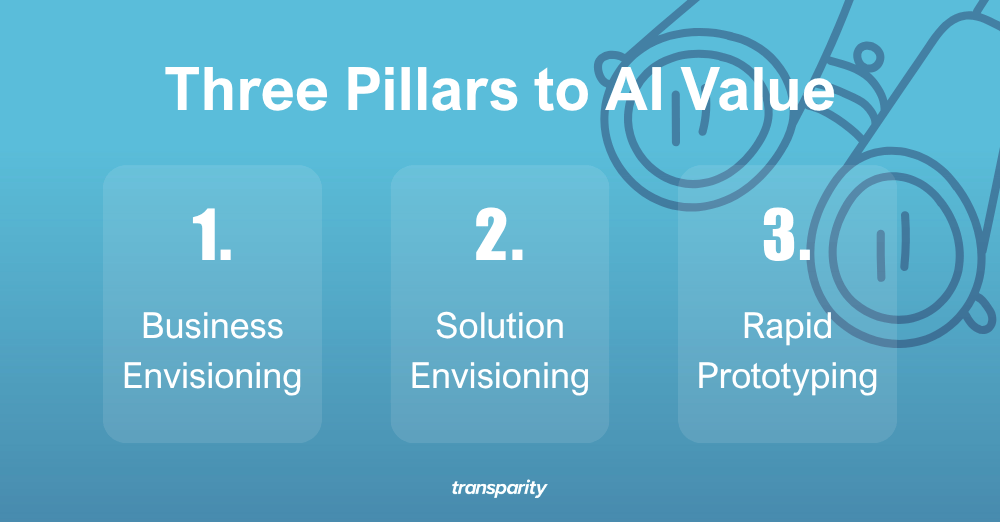
This phase combines three key elements that bring clarity and direction to your AI journey:
Business Envisioning: uncovering where AI can drive real business impact.
Solution Envisioning: mapping those opportunities to practical, achievable solutions.
Rapid Prototyping: proving what’s possible quickly and confidently.
By the end of this stage, organisations have a clear, prioritised roadmap of AI use-cases, each aligned to business goals and designed to deliver measurable ROI.
It’s not about experimenting endlessly. It’s about identifying high-value opportunities and turning them into results.
Pillar 1: Business Envisioning – Finding the Real Opportunities
Every AI success story starts with clarity. The Business Envisioning workshop is where that begins.
It’s a collaborative session bringing together business and IT leaders to explore your organisation’s pain points, inefficiencies, and growth opportunities. The goal is to move beyond generic statements like “we should automate more” and instead ask sharper questions:
How can we reduce claims handling time by 30%?
Where are manual processes holding back our teams?
How could we improve our customer experience?
Think of it as a business health check before prescribing AI as the cure, as remember, AI isn’t always the answer.
Using Microsoft’s proven envisioning frameworks, our consultants help identify areas where AI can truly make a difference in customer engagement, operational efficiency, or employee productivity.
As well as creating an overall Strategic vision, the result is a list of concrete opportunities grounded in business value, that are visualised in a prioritisation matrix mapped by value vs effort. This simple but powerful matrix helps organisations avoid the classic pitfall of overinvesting in complex, low-impact use cases. Instead, you get a roadmap of high-value initiatives that deliver quick wins while building momentum for long-term transformation.
As Microsoft’s research shows, organisations that take this structured approach to AI adoption are more likely to achieve measurable outcomes, rather than getting stuck in “fractured AI” experiments that never scale.
Pillar 2: Solution Envisioning – Designing What’s Possible
Once the business problems are clear, it’s time to design how AI can solve them and go into more detail on the success criteria to make a go/no-go decision.
In Solution Envisioning, Transparity’s experts work with your teams to connect each challenge to a feasible AI solution leveraging the entire Microsoft AI ecosystem, from Copilot StudiotoAzure AI.
This step bridges the gap between ideas and implementation. Together, we evaluate:
Technical feasibility: Is the data ready? What are the integrations needed?
Business impact: What’s the potential return and the detailed success criteria?
Risk and compliance: How do we ensure Responsible AI?
We then start designing the solution architecture, is this a low code or pro code solution? What data sources do we need to connect to and what tools/systems do we need to integrate with? How will the results be surface? What is the preferred user interface?
You will be left with a clear solution design for each use-case showcasing what a Proof of Value looks like.
Pillar 3: Rapid Prototyping – Seeing Is Believing
Even the best strategy needs to prove itself in the real world. That’s where Rapid Prototyping comes in.
This stage transforms one of your top-priority use cases into a small-scale working model, built collaboratively with Transparity’s AI engineers and your technical teams.
In just days, you’ll have a tangible proof of concept that demonstrates what the technology can achieve and how it fits your business processes.
The benefits are immediate:
Faster stakeholder buy-in: leaders can see results, not just slides.
User feedback early: the people who’ll use the solution can shape it.
Reduced risk: test feasibility before large-scale investment.
It’s AI you can touch and it turns abstract potential into visible progress.
Why This Approach Works
So why start here? Because Business & AI Journey to Value helps organisations achieve three things that most AI projects lack:
1. Speed to Value: by focusing on the right problems first, you avoid wasting time on low-impact ideas. Within weeks, you’ll have a prioritised roadmap and a working prototype that demonstrate measurable value.
2. Clarity: AI Factory cuts through the hype with a structured, transparent process. You’ll understand exactly which use cases deliver business outcomes and which are best left behind.
3. Confidence: with validated business cases, governance alignment, and early proof points, you can invest in AI with confidence knowing you’re building on solid foundations.
How This Differs from Other Approaches
Many organisations attempt AI adoption from the bottom up, starting with tools or pilots driven by individual teams. While well-intentioned, this “citizen-led” approach often leads to duplication, shadow projects, and inconsistent governance.
Transparity’s AI Factory flips this model. Business & AI Journey to Value unites business and technology leaders around a shared vision backed by the governance, strategy, and Microsoft frameworks that ensure success.
It’s about scaling AI deliberately, not accidentally.
Your AI Journey Starts Here
If your organisation is still asking, “Where should we start with AI?” this is the answer.
Component 1 of AI Factory lays the foundation for sustainable, value-driven AI adoption. It ensures that every initiative has a business case, every prototype has a purpose, and every success can be scaled.
That’s exactly why Transparity’s new AI Factory was created, to help businesses move from AI hype to AI impact. Built on deep Microsoft expertise, AI Factory delivers a structured, repeatable approach to making AI work for your organisation – quickly, securely, and at scale.
Why So Many AI Projects Stall
Across industries, teams are experimenting with AI but finding it difficult to deliver consistent, measurable outcomes. They may have built an early proof of concept, but lack the data infrastructure, governance, or operational model to deploy AI solutions confidently and sustainably.
The challenge isn’t enthusiasm, it’s execution. Without the right foundations and guidance, even promising AI ideas can fail to make the leap from concept to company-wide adoption. That’s where AI Factory steps in: giving organisations the clarity, structure, and expertise to build AI that lasts.
What Is Transparity’s AI Factory?
Think of AI Factory as your AI production line. It’s a framework and partnership designed to build, scale, and manage AI in a sustainable way. It’s not another platform or one-size-fits-all product; it’s a hands-on consultancy service that embeds Transparity’s cross-functional experts alongside your teams.
You’ll work with specialists in AI, Data, Cloud, Security, and Governance, people who live and breathe Microsoft technology. Together, they’ll help you cut through complexity, identify where AI can drive real business value, and deliver measurable outcomes at pace.
AI Factory brings together everything organisations need to turn ideas into outcomes:
Strategic clarity: identifying use cases that align with your business goals
Rapid delivery: through agile, sprint-based execution
Continuous improvement: with responsible, monitored operations
The result? A practical, governed, and repeatable model for operationalising AI, not just another short-term project.
The Components of AI Factory
AI Factory follows a proven framework to move organisations from strategy to scaled implementation:
1. Strategy & Discovery
Every engagement begins with defining your AI vision and strategy. Through focused workshops, Transparity helps you pinpoint where AI can deliver genuine value, prioritising impact over novelty. The outcome is a clear plan that connects AI initiatives directly to business objectives.
2. Strong Foundations
Transparity ensures your data, governance, and security posture are ready for AI. By establishing a robust landing zone in Azure, your AI workloads operate within hardened, compliant guardrails from the start which is essential for scaling AI responsibly.
3. AI Ready Roadmap
Together, we build a prioritised roadmap of AI use cases based on effort versus impact. This roadmap highlights the quick wins that accelerate ROI, while also identifying the foundational work needed to enable long-term transformation.
4. Sprint-Based Delivery
Using an agile, sprint-based model, Transparity develops and deploys AI solutions in short, focused bursts, delivering tangible business outcomes in weeks, not months. Collaboration with your teams ensures solutions are usable, adoptable, and scalable.
5. Ongoing Support & Improvement
AI Factory doesn’t end at deployment. Transparity provides continuous monitoring, optimisation, and executive guidance — embedding Responsible AI and observability throughout. Through a GenAIOps approach, your AI operations remain governed, reliable, and adaptive as your business evolves.
And because AI Factory is a cyclic process with no end point, it enables ongoing innovation, allowing you to continuously build, test, and scale new AI solutions as part of a living, repeatable model.
Why AI Factory Matters
There’s no shortage of AI consultants, but AI Factory stands apart because it delivers real outcomes fast and keeps them sustainable.
1. Speed to Value
By combining proven frameworks with agile delivery, AI Factory cuts typical AI project timelines from months to weeks. You see measurable impact sooner helping you to maintain momentum and stakeholder confidence.
2. Built on Microsoft Expertise
As a trusted Microsoft Solutions Specialised Partner, Transparity’s team brings deep experience in Azure AI, Copilot Studio, and AI governance. You gain immediate access to a ready-made team of experts without needing to recruit or retrain internally.
3. Tailored to You
Every solution is designed for your unique data, systems, and goals. Whether you need intelligent document processing, predictive analytics, or conversational AI, AI Factory adapts to your environment to deliver practical business results.
4. Governed and Transparent
AI Factory embeds governance, security, and Responsible AI practices from day one. Every model is explainable, compliant, and auditable so that your leadership and regulators can trust the outcomes.
5. Scalable and Sustainable
Most importantly, AI Factory builds the foundations for long-term scalability. It’s not a one-off implementation, it’s an operating model for continuous, governed AI adoption.
Real-World Impact
AI Factory is already helping organisations move from exploration to execution.
One UK construction firm, for instance, partnered with Transparity to tackle project cost overruns. In just a few sprints, the team delivered a predictive AI model that identified budget risks early, helping managers take proactive action. The result: improved efficiency, reduced waste, and faster ROI.
Similar success stories span industries – from professional services firms modernising their data foundations to healthcare providers deploying AI triage assistants. Each engagement demonstrates the same outcome: secure, scalable AI solutions that deliver tangible value.
Who AI Factory is For
AI Factory is designed for business and IT leaders ready to take the next step in their AI journey. Whether you’re:
Just defining your AI strategy,
Building the data and governance foundations, or
Looking to scale from pilot to enterprise-wide adoption
AI Factory meets you where you are.
It’s ideal for organisations that:
Have started AI pilots but can’t scale them
Need an AI-ready infrastructure and governance framework
Want faster, safer ROI from AI investments
Delivered in partnership with Microsoft, AI Factory combines Transparity’s proven expertise with your in-house knowledge to build lasting AI capability whilst embedding skills and confidence along the way.
Getting Started
Getting started is simple. Transparity begins with a Strategy & Discovery workshop to assess your current state, identify high-impact opportunities, and map your first AI use-cases. From there, the team helps establish your secure Azure landing zone and delivers your first use case through sprint-based execution that’s fast, focused, and measurable.
The Transparity Way
AI Factory represents Transparity’s belief that AI should be practical, transparent, and human-centred. It’s about helping organisations cut through the noise, accelerate adoption, and build governed, scalable AI that drives meaningful transformation.
If you’re ready to move from AI hype to AI that works, now’s the time to act. Let’s discover, design, and deliver genuine transformation together.
Artificial intelligence (AI) is no longer a futuristic concept, it’s shaping industries and revolutionising business landscapes today. But with the rapid pace of innovation, how can businesses best adopt AI?
We have seen that with the right AI strategy, you can drive innovation, optimise processes, and create transformative business value.
In this blog, we’ll explore the innovative ways businesses are leveraging AI, where it makes the most impact and how to approach it.
What Are the Innovative Ways Businesses Are Adopting AI?
We are seeing that the most transformational AI initiatives are designed to achieve one of these four business outcomes: enriching employee experiences, reinventing customer experience, reshaping business processes or accelerating innovation.
1: To increase employee productivity
AI can help increaseemployee productivity and wellbeing, whether that’s through automating mundane tasks or offering access to personalised insights and critical data. An example of this is RNIB, through adopting Microsoft 365 Copilot their employees have saved 4 hours per week, translating to an 11% increase in workweek efficiency.
Breaking Barriers with AI: How Microsoft 365 Copilot is Transforming Accessibility at RNIB
“The first time I used Copilot, I had to create an accessible document. Instead of wasting hours navigating inaccessible websites, I simply typed a few prompts, and Copilot did the rest. It was mind-blowing – what once took hours now took minutes.”
AI can reinventcustomer experiences through enhanced self-service options along with more personalised engagements. Contact Center transformation is one of the most impactful areas where we are seeing AI being leveraged. With the rise of 24/7 customer support agents and agent assistance for case summarisation and next best action – this is also transferable to internal IT Helpdecks. We’ve also seen great examples of how AI can support the entire customer journey through automating content creation at scale, helping teams launch marketing campaigns faster, right through to recommendation engines creating more personalised buying experiences for consumers.
3: To transform business processes
Transforming business processes is another way AI is encouraging innovation and improving efficiency across various business functions as companies reimagine their back-to-office of the future. For supply chain management, AI can predict market trends so companies can optimise their inventory planning and demand forecasting. HR departments can leverage AI to speed up their hiring and onboarding process, while Finance can use it for forecasting, fraud detection and risk assessments. Another great example of infusing AI into daily operations is how AI is being leveraged for bidding/tendering for new work. An example of this is how BMT can now navigate and utilise their extensive project data with unprecedented ease and efficiency to help them win more work
AI Infused Bid Management Application for BMT
“With the support of Transparity and Microsoft, we have now successfully scaled and implemented Generative AI into BMT and are actively using this technology with our customers.” Simon Willmore, Head of Digital Strategy
And finally, AI can accelerate innovation by speeding up creative processes and product development. This is done by AI providing R&D, product, and engineering teams with access to deeper knowledge and insights, the ability to quickly analyse market trends and having development tools they use to self-learn and continuously improve. This allows them to come up with new ideas, design prototypes, and iterate quickly, cutting down the time it takes to get to market. In the automotive industry AI is helping to design more efficient vehicles, while in pharmaceuticals, it’s crafting new drug molecules.
You can see over 400 examples of how companies are doing this here: How real-world businesses are transforming with AI — with more than 140 new stories – The Official Microsoft Blog
Identifying impactful use cases begins with understanding business challenges. Businesses should evaluate where AI can automate repetitive tasks, optimise processes, or enhance customer experience.
A prioritisation matrix helps to balance the right mix of effort required/time to production vs. business value to identify “quick wins” and also your larger, transformative projects. It is crucial to align use cases with strategic objectives to ensure measurable returns and build a business case for investment.
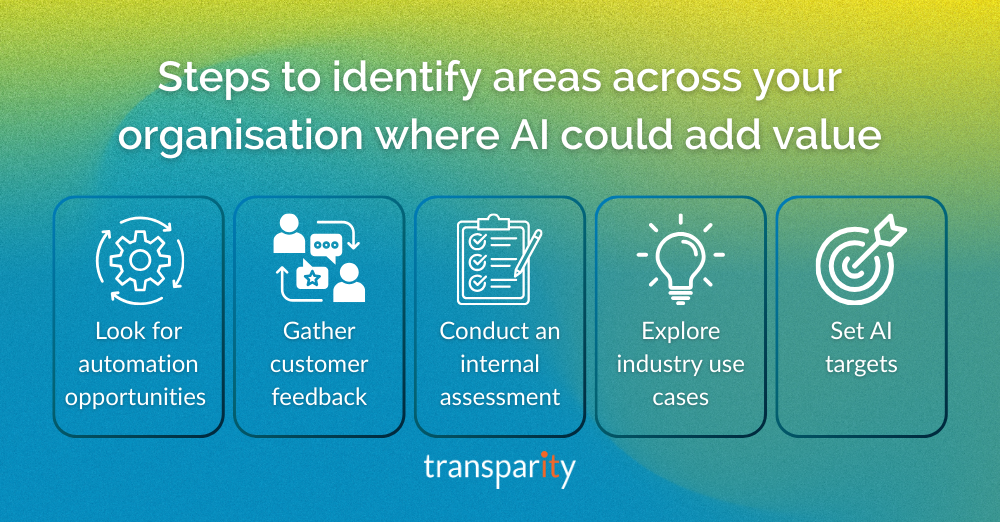
With this understanding, identify areas across your business where AI could add value:
Look for automation opportunities
Identify processes suitable for automation to improve efficiency and reduce operational costs. Focus on repetitive tasks, data-heavy operations, or areas with high error rates where AI can have a significant effect.
Gather customer feedback
Use customer feedback to uncover use cases that would have an impact on customer satisfaction when automated with AI.
Conduct an internal assessment
Gather input from various departments to identify challenges and inefficiencies that AI could address. Document workflows and gather input from stakeholders to uncover opportunities for automation, insight generation, or improved decision-making.
Explore industry use cases
Research how similar organisations or industries use AI to solve problems or enhance operations.
Set AI targets
For each identified use case, clearly define the goal (general purpose), objective (desired outcome), and success metric (quantifiable measure). These elements serve as benchmarks to guide your AI adoption and measure success.
Why Should Businesses Consider Leveraging AI?
Microsoft recently commissioned a study with IDC, The Business Opportunity of AI, to uncover new insights around business value and help guide organisations on their journey of AI transformation. The study found that:
For every $1 organisations invest in generative AI, companies are realising an average of $3.70 in return.
92% of AI deployments are taking 12 months or less
Organisations are realising a return on their investments within 14 months
AI capability is growing and evolving every day, and studies show that Generative AI usage grew from 55% in 2023 to 75% in 2024. If you don’t start on your AI journey soon, the capability gap will continue to grow, meaning there is a risk your organisation will get left behind vs your peers and competitors.
Where Should Businesses Apply AI, and Where Should They Not?
AI should be applied where it can create tangible benefits. Focus on areas with clear business outcomes, such as improving customer service, automating administrative tasks, or informing decisions. For example, AI is excellent for repetitive tasks or areas that involve large amounts of data that humans would struggle to process manually.
Businesses should avoid using AI in areas lacking clear objectives and anywhere that requires complex human judgment or emotional intelligence, these are areas such as highly sensitive negotiations or situations where deep empathy is needed.
Additionally, businesses should refrain from applying AI where data is scarce or inaccurate, as this can lead to poor decisions and undermine trust in AI systems.
Finally, businesses should avoid applying AI to situations where ethical concerns (e.g. bias or privacy issues) outweigh potential benefits. Responsible AI use is critical to maintaining trust and ensuring positive outcomes.
What Is an AI Strategy? What Are the Benefits?
An AI strategy is a comprehensive plan that outlines how an organisation will integrate AI technologies to meet its business objectives. An effective AI strategy ensures resources are focused on high-impact areas, fosters innovation, and builds capabilities for long-term success to maximise ROI and minimise risks. It provides clarity, promotes alignment and accelerates measurable value realisation across functions.
It does this through identifying high-value, feasible use cases, selecting the right technologies, and creating a roadmap for deployment. It also addresses data foundations, identifies the skillset and resources needed to implement and finally, the ethical considerations involved in using AI to ensure you are deploying AI responsibly.
How Should Businesses Approach Their AI Strategy?
At Transparity, we break our AI Strategy down into 3 main areas underpinned by our Responsible AI principles:
Building your AI Foundations; aligning on your AI Vision, helping you to identify and prioritise your use-cases, plus any foundational needs, e.g. hardening your landing zone to be AI ready, into a clear roadmap.
Designing your AI Workloads; selecting the right technology to build your AI solutions that align with your business and technical requirements for both proving the value and deployment into production.
Ongoing Management, Governance and Security of your AI Workloads to ensure visibility, explainability and consistency throughout your AI lifecycle.
How Can Businesses Get Started?
At Transparity, we offer a free 2-hour AI Readiness Assessment that benchmarks your maturity and makes recommendations across the following areas to start building out your AI Strategy and next steps:
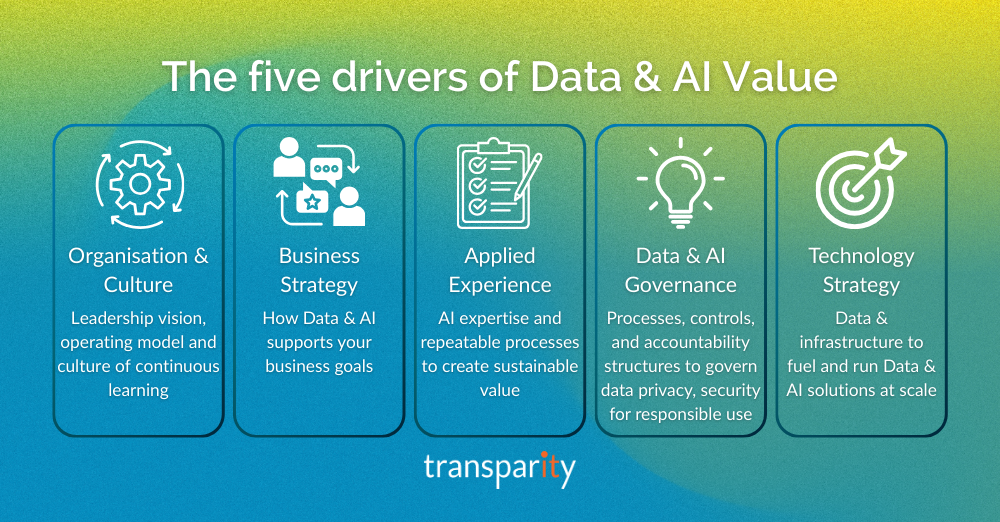
Organisation & Culture: do you have a clear operating model, leadership support, change-management process, access to continuous AI learning and development, and strong relationships with diverse subject-matter experts?
Business Strategy: do you have clearly defined and prioritised business objectives, use cases, and measurement of AI value?
AI Experience: do you have a systematic, customer-centric approach to AI that includes applying the right model to the right use case and experience in building, testing, and realising AI value across multiple business units?
Data & AI Governance: have you implemented any processes, controls, and accountability structures to govern data privacy, security, and the responsible use of AI?
Technology Strategy: do you have an AI-ready application and data platform architecture, aligned parameters for build vs. buy decisions, and plans for where to host data and applications to optimise outcomes?
AI isn’t the future of work; it’s already transforming how businesses operate today. Organisations that embrace AI-powered tools like Microsoft 365 (M365) Copilot are seeing dramatic improvements in efficiency, accessibility, and productivity. At Transparity, we’re helping businesses unlock AI’s full potential and the impact is game-changing.
We see AI, and M365 Copilot specifically, as an essential force shaping the modern workplace. M365 Copilot isn’t about replacing employees, it’s about enhancing their capabilities and empowering them to work smarter. From drafting emails and generating reports to intelligently surfacing information, M365 Copilot acts as a true collaborator, streamlining repetitive tasks so employees can focus on more strategic work.
At Transparity, we don’t just implement AI, we help organisations integrate it in a way that drives real value. The future of work is here, and with M365 Copilot, businesses can ensure they’re ahead of the curve.
Why Microsoft 365 Copilot is reshaping the modern workplace
Microsoft 365 Copilot is more than just an automation tool; it’s an intelligent collaborator, helping employees work smarter and focus on higher-value tasks.
Boosting workplace efficiency
From summarising meetings to drafting documents, Microsoft 365 Copilot streamlines daily tasks, reducing time spent on repetitive admin work. Employees can focus on strategic thinking, creativity, and decision-making, making businesses more agile and cost-effective.
Enhancing accessibility
One of M365 Copilot’s most powerful impacts is in making work more accessible for all. It empowers employees with disabilities by enabling greater independence in tasks like document creation, email composition and information retrieval.
Transforming Industries
Across finance, healthcare, non-profits, and other sectors, Microsoft 365 Copilot is driving industry-specific innovation. For example, in finance it accelerates reporting and analysis, in customer service it improves response times and enhances personalisation, and in non-profits it enables better resource allocation and donor engagement.
Transparity: your trusted Microsoft 365 Copilot implementation partner
Rolling out M365 Copilot isn’t just about switching it on. At Transparity, we work closely with organisations to ensure AI is implemented with purpose, from training employees to integrating it seamlessly into existing workflows.
We rolled out Microsoft 365 Copilot to 60% of our organisation and have seen tremendous impact across enhanced employee productivity and wellbeing. By offering tailored training, a phased rollout, and continuous support, we empowered our teams to work smarter and more efficiently. This has perfectly placed us to take those learnings and now support our customers in implementing M365 Copilot from both a technical readiness and an adoption, change management perspective.
Read our blog to learn how we successfully rolled out M365 Copilot and the key steps you can take to get started
We know that each organisation is unique, so we work with our clients to assess where they currently are and where they want to get to; creating a personalised plan for their technical readiness and adoption & change management needs plus how these fit into their wider AI Strategy.
Increased Autonomy – Employees complete tasks independently with AI assistance.
Saved Time – Up to 4 hours saved per week per employee.
Scaled Rapidly – Starting with 30 licenses, now at 300 and growing.
As RNIB shares, “For our blind and partially sighted employees, Copilot isn’t just a productivity tool, it’s an enabler of independence. It’s changed the way we work.”
“I can do it now!” How Copilot and Transparity transformed accessibility for RNIB
AI will continue to become more ubiquitous and accessible, empowering both technical and non-technical users to leverage its capabilities. Working alongside people, boosting creativity, improving efficiency, and automating repetitive tasks. We’re already seeing breakthroughs in industries like healthcare, education, and customer service, and the pace of change will only accelerate.
A lot of conversations with customers are still centred around AI Design and whether they should buy, extend or build. We always start by encouraging clients to decide on the why; defining clear business goals is essential to realising sustainable business value. Once you have determined your objectives, you can then decide how to apply AI to reach those goals, from buying off-the-shelf Software as a Service (SaaS) solution with AI already infused, to building a custom solution that suits your specific needs.
This brings us to the rise of AI Agents, and moving from M365 Copilot working with you, to an Agent working on behalf of you! AI Agents themselves can vary in complexity and capability.
Retrieval involves fetching relevant information or data to assist decision-making.
Task performs specific, predefined tasks based on user input or instructions.
Autonomous Agents or Agentic AI go one step further by making independent decisions and taking actions without human intervention, adapting to situations based on learned experiences. These systems can carry out tasks and solve problems without constant oversight.
We are seeing most of our customers starting with the simpler models of Retrieval and Task-based Agents, but it will only be a matter of time before they start exploring the world of Autonomous Agents with our support and frameworks. While the potential to drive innovation and efficiency is huge, responsible deployment is essential to ensure the ethical and transparent use of these technologies.
“AI is evolving from a M365 Copilot assisting employees to AI Agents working autonomously. These AI systems will not only collect data and perform predefined tasks but also make decisions and take actions independently. While this unlocks new efficiencies, responsible deployment is crucial, ensuring transparency and ethical considerations remain a priority.”
Take the next step
We’re only just beginning to understand the full potential of AI. In the next five years, tools like M365 Copilot will be as integral as email is today. This means businesses that embrace AI early will have a distinct advantage. The technology is already here, and if you wait too long to adopt it, the gap will only grow, making it harder to catch up.
Now is the time to explore how AI can transform your business. Transparity’s Copilot Consultancy Service and our AI Maturity Assessment helps organisations assess their AI readiness and implement M365 Copilot successfully.
Friday 22nd November wrapped up the end of another fantastic Microsoft Ignite event and what a spectacle it was, so much to digest!
This year, it was great to be back in person in Chicago alongside 14,000 other attendees, to witness the latest groundbreaking advancements across the Microsoft technology stack.
With around 80 new products and features announced and more than 800 sessions, demos and expert-led labs to choose from, I thought it would be useful to summarise 5 of my favourite announcements and sessions for those who couldn’t attend the live event and are looking to catch up on demand. I also include useful links to where you can find further information.
1. Copilot Momentum
From experimental pilots to enterprise deployments, Copilot momentum is everywhere. Microsoft shared that nearly 70% of the Fortune 500 now use Microsoft 365 Copilot, highlighted here with more than 200 customer stories of AI Transformation.
There were many announcements across the Copilot stack focused on adoption, extensibility and ROI.
Interpreter
Enables real-time speech-to-speech interpretation in Teams meetings so each participant can speak and listen in the language of their choice. Available for Public Preview in Q1 2025.
Agents in SharePoint available now
Generate an up-to-date summary of important information hosted on SharePoint sites, including key insights and comparing documents.
Autonomous agents are now in preview
Makers can now build agents that work on their behalf, without having to prompt the agent, saving human hours and increasing efficiency.
Viva Insights in Copilot Analytics
Viva Insights will now be included in Microsoft 365 Copilot at no additional charge as part of the new Copilot Analytics. Find out more on Copilot Analyticshere.
A unified application platform to design, customise, and manage AI solutions. There’s SO much to unpack! I really recommend checking out Asha Sharma’s session called “Azure AI Foundry unlocking the AI revolution” else, you can also find out more here and watch it in actionhere.
Some of the key features include:
A Unified AI toolchain in a new Azure AI Foundry SDK that makes Azure AI capabilities accessible from familiar tools, like GitHub, Visual Studio, and Copilot Studio.
New Azure AI Agent Service to automate business processes
Enhanced observability and collaboration with Azure AI Foundry Portal. Evolving Azure AI Studio into an enterprise-grade management console.
Expanded AI model catalogue with 1800+ models to choose from and more RAG performance with Azure AI Search
Responsible AI tooling to help ensure safety and compliance.
3. Data Security Takes Centre Stage
Satya opened Ignite by saying “Purview is the product of the conference because in the age of AI, Data Governance takes on an even more critical, central and important role”
Compliance Manager and the new AI reports capability can help you prepare for AI regulations, such as the EU AI Act.
Insider Risk Management now enables you to detect and investigate potential prompt injection attacks in Microsoft 365 Copilot and anomaly activities in Copilot, ChatGPT Enterprise, and agents built in Copilot Studio.
Data Security Posture Management (DSPM) for AI helps you proactively discover risks, such as sensitive data in prompts, and get recommended actions to address them.
New capabilities in the Azure portal and Defender for Cloud can now help you govern model deployment and strengthen security posture, proactively reducing vulnerabilities in your environment.
Learn more about all these new capabilities in the announcement blog post here.
4. Exposure Management
Microsoft made some significant commitments to Security with the launch of the Secure Future Initiative (SFI) last year – prioritising the integration of secure by design, secure by default, and infusing secure operations principles into everything they do. We expected to see a number of announcements at Ignite as a consequence, and we weren’t disappointed!
One of the biggest bits of news – referenced in Satya’s keynote – was the general availability of Security Exposure Management. This is a tool we’ve been using internally at Transparity for some time that we’re excited to be able to position with confidence to our customers. Exposure Management provides a unified solution to assess and reduce cyberthreat exposure. It consolidates data for a comprehensive view of the attack surface; providing ongoing assessments and prioritised recommendations to enhance security posture.
Alongside the Exposure Management and Purview updates I’ve already mentioned, Ignite also saw a host of other SCI related enhancements. This short summary doesn’t do justice to the immense capability being added, but you’d do well to check out “Transform your security with GenAI innovations in Security Copilot” (BRK307) for a snapshot of some of the functionality and integration work that Microsoft is doing to unify and enhance the experience and workflow for Security stakeholders – largely via Security Copilot.
Here are some of my highlights:
AI driven assistance in the Microsoft Entra Admin Center to deliver insights across identity telemetry including audit and diagnostic logs, sign-in data, application risk, and user insights.
New integration with Microsoft Intune to simplify the assessment, troubleshooting, and management of endpoints – including AI-driven KQL query assistance.
A new Logic Apps connector to enable the running of Security Copilot promptbooks directly from the Logic Apps workflow – enriching insights for Security admins, and automating common tasks.
Extended Threat Intelligence via the new (preview) Unified Threat Intelligence Experience to help security teams more rapidly assess and understand potential threats.
Ignite 2024 was a testament to Microsoft’s commitment to AI innovation and security, with a plethora of new features and updates that promise to transform the way we work and interact with technology. I, for one, can’t wait to get back home to start trying these new capabilities out!
A summary of the most exciting AI announcements from Microsoft’s annual developer conference
Microsoft Build, the company’s annual developer conference, took place from May 21 to May 23, 2024. This year’s event emphasized the transformative impact AI technology is having on organisations leveraging it to enhance efficiencies, elevate customer experiences and achieve differentiating innovations. At Transparity, we are witnessing a turning point in the market as AI moves from vision to everyday reality and Microsoft is bringing that to the forefront with their latest announcements.
In this blog, we will focus on some of the key AI announcements that Microsoft made during the event and what they mean for the future of AI development and adoption.
Empowering you with a broad selection of small and large language models
Microsoft provides you with more than 1,600 models through their model catalog in Azure AI Studio. This enables you to have the flexibility to compare cost & performance, giving you the ability to select the right model for your use-case and business needs.
At Build, Microsoft added to this with:
GPT-4o, OpenAI’s new flagship model is now generally available in Azure OpenAI Service. You may have seen the latest innovation from OpenAI: GPT-4o, which showcases incredible multi-modal demos across text, vision, and audio. API includes support for text and image with audio support coming soon. Dive into GPT-4o’s capabilities with the playground available in Azure OpenAI Studio.
Phi-3: Redefining what’s possible with SLMs. Announcing Phi-3-small, Phi-3-medium, and Phi-3-vision, a new multimodal model, in the Phi-3 family of AI small language models (SLMs), developed by Microsoft. Phi-3 models are powerful, cost-effective and optimized for resource constrained environments including on-device, edge, offline inference, and latency bound scenarios where fast response times are critical.
To learn more about the following announcements and the new ways Azure is helping you to build transformational AI experiences, read the blog post by Jessica Hawk, CVP, Data, AI, Digital Applications Marketing.
New agent capabilities in Microsoft Copilot unlock business value
Microsoft announced a host of new powerful capabilities in Microsoft Copilot Studio—the single conversational AI tool you can use to create your very own custom copilots or extend Microsoft Copilot experiences with your own enterprise data and scenarios.
Copilot can now act as independent agents—ones that can be triggered by events—not just conversation—and can automate and orchestrate complex, long-running business processes with more autonomy and less human intervention:
New Copilot agents with Copilot Studio: developers can build copilots for specific functions that respond to data and events and can autonomously complete long-running processes. These new agent capabilities are currently available in a limited early access preview and will be released for public preview later this calendar year.
Introducing Copilot Connectors: Organisations want copilots to be able to reason over and use data from their own enterprise’s business systems and apps. Copilot connectors enable anyone to ground their copilot with a curated catalog of data sources including Dataverse, Microsoft Fabric OneLake (coming this calendar year.) Copilot connectors will be available in public preview soon.
To learn more about all of the powerful capabilities announced for Microsoft Copilot Studio, read the blog post by Omar Aftab, Vice President, Conversational AI.
60+ Announcements
These are just some of the highlights of the AI announcements that Microsoft made at Build 2024:
See the full set of announcements: read the Book of News, the Official Microsoft Blog, and the hero blogs and resources linked above to learn more about their key announcements.
We hope you are as inspired and excited by the possibilities and opportunities that AI can bring to your development and business goals as we are. These AI advancements are creating a myriad of new use-cases, and we are starting to see more of a shift from ideas to production. We are working with our customers every day to unlock business challenges; helping them to create more personalised customer experiences, optimise their operations and jump start that creative process to become more innovate.
If you would like a conversation with our Data & AI team on how to get started and take your ideas into production, then please reach out to us for a chat or an AI Readiness assessment.

 With this understanding, identify areas across your business where AI could add value:
 Additionally, businesses should refrain from applying AI where data is scarce or inaccurate, as this can lead to poor decisions and undermine trust in AI systems.
Finally, businesses should avoid applying AI to situations where ethical concerns (e.g. bias or privacy issues) outweigh potential benefits. Responsible AI use is critical to maintaining trust and ensuring positive outcomes.
Additionally, businesses should refrain from applying AI where data is scarce or inaccurate, as this can lead to poor decisions and undermine trust in AI systems.
Finally, businesses should avoid applying AI to situations where ethical concerns (e.g. bias or privacy issues) outweigh potential benefits. Responsible AI use is critical to maintaining trust and ensuring positive outcomes.