4: To accelerate innovation
And finally, AI can
accelerate innovation by speeding up creative processes and product development. This is done by AI providing R&D, product, and engineering teams with access to deeper knowledge and insights, the ability to quickly analyse market trends and having development tools they use to self-learn and continuously improve. This allows them to come up with new ideas, design prototypes, and iterate quickly, cutting down the time it takes to get to market. In the automotive industry AI is helping to design more efficient vehicles, while in pharmaceuticals, it’s crafting new drug molecules.
You can see over 400 examples of how companies are doing this here:
How real-world businesses are transforming with AI — with more than 140 new stories – The Official Microsoft Blog
Identifying impactful use cases begins with understanding business challenges. Businesses should evaluate where AI can automate repetitive tasks, optimise processes, or enhance customer experience.
A prioritisation matrix helps to balance the right mix of effort required/time to production vs. business value to identify “quick wins” and also your larger, transformative projects. It is crucial to align use cases with strategic objectives to ensure measurable returns and build a business case for investment.
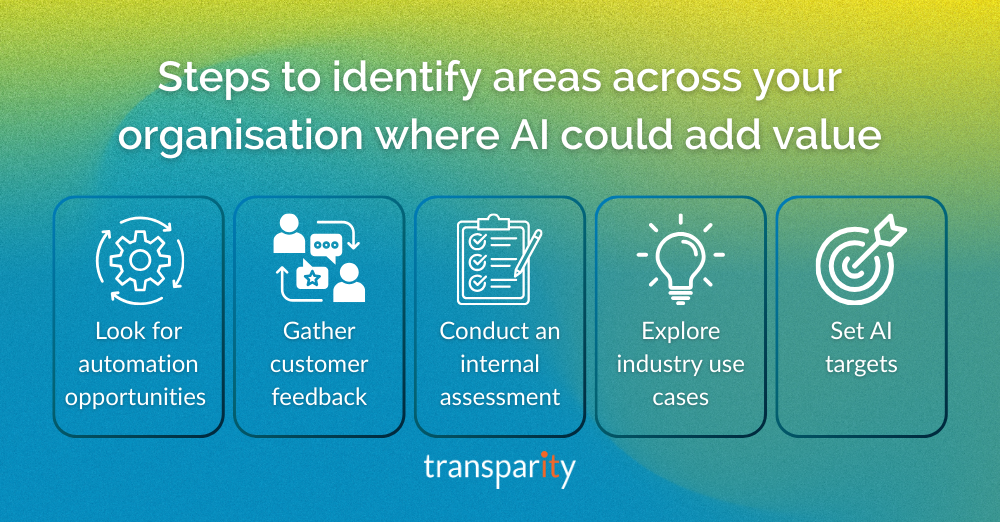
With this understanding, identify areas across your business where AI could add value:
Look for automation opportunities
Identify processes suitable for automation to improve efficiency and reduce operational costs. Focus on repetitive tasks, data-heavy operations, or areas with high error rates where AI can have a significant effect.
Gather customer feedback
Use customer feedback to uncover use cases that would have an impact on customer satisfaction when automated with AI.
Conduct an internal assessment
Gather input from various departments to identify challenges and inefficiencies that AI could address. Document workflows and gather input from stakeholders to uncover opportunities for automation, insight generation, or improved decision-making.
Explore industry use cases
Research how similar organisations or industries use AI to solve problems or enhance operations.
Set AI targets
For each identified use case, clearly define the goal (general purpose), objective (desired outcome), and success metric (quantifiable measure). These elements serve as benchmarks to guide your AI adoption and measure success.
Why Should Businesses Consider Leveraging AI?
Microsoft recently commissioned a study with IDC,
The Business Opportunity of AI, to uncover new insights around business value and help guide organisations on their journey of AI transformation.
The study found that:
- For every $1 organisations invest in generative AI, companies are realising an average of $3.70 in return.
- 92% of AI deployments are taking 12 months or less
- Organisations are realising a return on their investments within 14 months
AI capability is growing and evolving every day, and studies show that Generative AI usage grew from 55% in 2023 to 75% in 2024. If you don’t start on your AI journey soon, the capability gap will continue to grow, meaning there is a risk your organisation will get left behind vs your peers and competitors.
Where Should Businesses Apply AI, and Where Should They Not?
AI should be applied where it can create tangible benefits. Focus on areas with clear business outcomes, such as improving customer service, automating administrative tasks, or informing decisions. For example, AI is excellent for repetitive tasks or areas that involve large amounts of data that humans would struggle to process manually.
Businesses should avoid using AI in areas lacking clear objectives and anywhere that requires complex human judgment or emotional intelligence, these are areas such as highly sensitive negotiations or situations where deep empathy is needed.
Additionally, businesses should refrain from applying AI where data is scarce or inaccurate, as this can lead to poor decisions and undermine trust in AI systems.
Finally, businesses should avoid applying AI to situations where ethical concerns (e.g. bias or privacy issues) outweigh potential benefits.
Responsible AI use is critical to maintaining trust and ensuring positive outcomes.
What Is an AI Strategy? What Are the Benefits?
An
AI strategy is a comprehensive plan that outlines how an organisation will integrate AI technologies to meet its business objectives. An effective AI strategy ensures resources are focused on high-impact areas, fosters innovation, and builds capabilities for long-term success to maximise ROI and minimise risks. It provides clarity, promotes alignment and accelerates measurable value realisation across functions.
It does this through identifying high-value, feasible use cases, selecting the right technologies, and creating a roadmap for deployment. It also addresses data foundations, identifies the skillset and resources needed to implement and finally, the ethical considerations involved in using AI to ensure you are deploying AI responsibly.
How Should Businesses Approach Their AI Strategy?
At Transparity, we break our AI Strategy down into 3 main areas underpinned by our Responsible AI principles:
- Building your AI Foundations; aligning on your AI Vision, helping you to identify and prioritise your use-cases, plus any foundational needs, e.g. hardening your landing zone to be AI ready, into a clear roadmap.
- Designing your AI Workloads; selecting the right technology to build your AI solutions that align with your business and technical requirements for both proving the value and deployment into production.
- Ongoing Management, Governance and Security of your AI Workloads to ensure visibility, explainability and consistency throughout your AI lifecycle.
How Can Businesses Get Started?
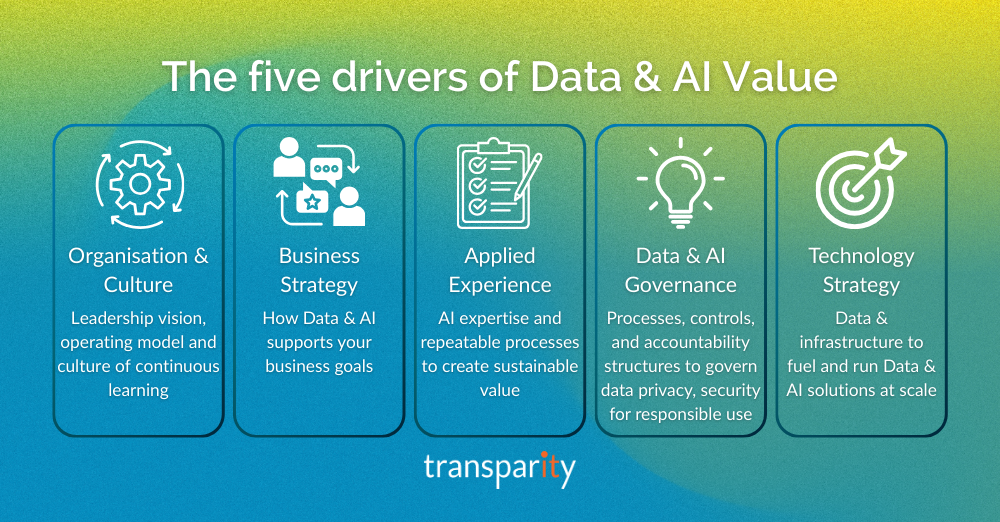
At Transparity, we offer a free 2-hour AI Readiness Assessment that benchmarks your maturity and makes recommendations across the following areas to start building out your AI Strategy and next steps:
- Organisation & Culture: do you have a clear operating model, leadership support, change-management process, access to continuous AI learning and development, and strong relationships with diverse subject-matter experts?
- Business Strategy: do you have clearly defined and prioritised business objectives, use cases, and measurement of AI value?
- AI Experience: do you have a systematic, customer-centric approach to AI that includes applying the right model to the right use case and experience in building, testing, and realising AI value across multiple business units?
- Data & AI Governance: have you implemented any processes, controls, and accountability structures to govern data privacy, security, and the responsible use of AI?
- Technology Strategy: do you have an AI-ready application and data platform architecture, aligned parameters for build vs. buy decisions, and plans for where to host data and applications to optimise outcomes?