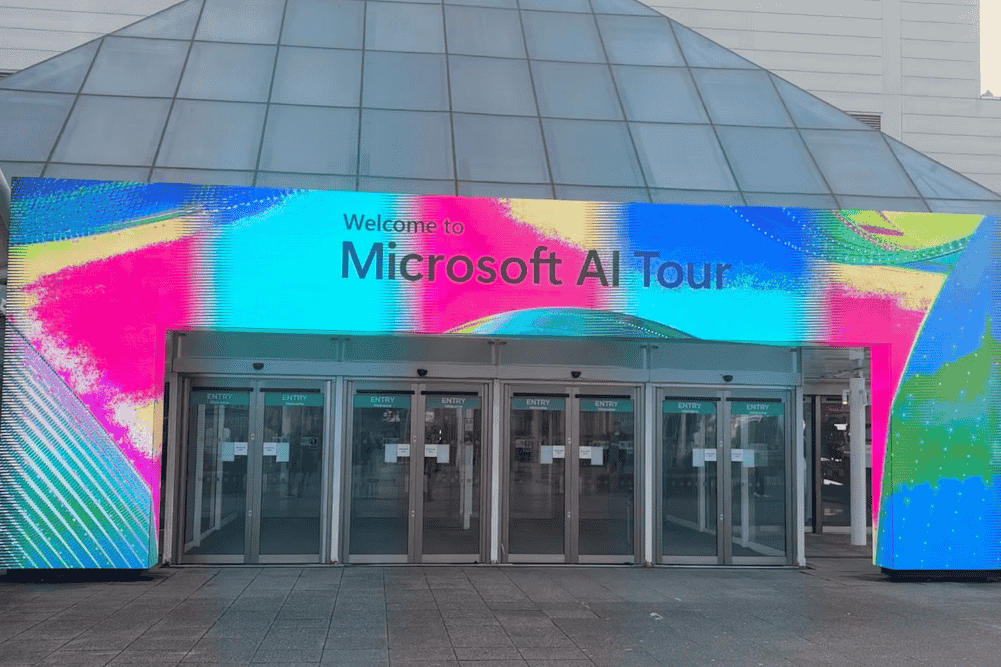

This week, thousands of customers, partners, and tech leaders packed into London’s ExCeL for the Microsoft AI Tour. It was brilliant. The energy, the conversations, the sheer scale of what’s happening with AI right now, it was impossible not to get excited.
But here’s the thing: this wasn’t another event full of buzzwords and vague promises about “AI transformation”. This was different. Microsoft came with a clear message: the age of AI experimentation is over. Enterprise AI is now about measurable outcomes, connected systems, and humans working alongside machines to get real work done.
As Transparity’s Microsoft Alliances Director, I spent the day soaking it all in – keynotes, breakout sessions, partner discussions, the lot. What struck me most wasn’t just the tech (though that was impressive), it was the shift in mindset. We’re moving from “look what AI can do!” to “here’s exactly how AI will improve your business”.
The Big Question: Can You Prove It?
Satya Nadella opened with a question that cuts right to the heart of enterprise AI:
“Can we measure where we started and prove meaningful improvement?”
It’s such a simple question, but it changes everything. No more pilots that go nowhere. No more “AI for AI’s sake”. If you can’t measure the impact, you’re just playing with expensive toys.
This is where AI moves from promise to proof. Whether you’re improving customer service response times, optimising supply chains, or streamlining finance operations, the focus has to be on outcomes. What gets better? How do you know? Can you show the data?
That’s the new bar. It’s also why a clearly defined AI strategy — one anchored in measurable business outcomes rather than technology for its own sake — is now the essential starting point for any enterprise AI programme.
Think End-to-End, Not Function-by-Function
One of the strongest themes from the event was this: stop deploying AI in isolated silos.
Too often, businesses optimise one function (marketing, sales, engineering) without thinking about how work actually flows across the organisation. Marketing feeds sales. Sales feeds engineering. Engineering feeds operations. You get the picture.
AI has to observe, learn from, and support these interconnected processes. Otherwise, you’re just making individual departments slightly faster at doing their own thing. Real enterprise impact comes from understanding the whole system and redesigning workflows end-to-end.
It requires leaders to think systemically. Not “how do we make finance more efficient?” but “how does our entire operation work together, and where can AI unlock the most value?”.
Skills and Data: The Foundation Everything Else Sits On
Two things came up again and again: skills and data.
Skills
Your people need the capability and confidence to work with AI tools, agents, and new interfaces. Without that, even the best technology stalls. You can’t just drop AI into an organisation and expect magic. You need to train, support, and empower your teams to use it effectively. Tools like Microsoft 365 Copilot are only as effective as the people using them – getting adoption right is just as important as the deployment itself.
Data with Context
The sharper your organisational context, the more valuable your data becomes. Data assets must be structured and governed in ways that directly support business outcomes, not just stored or aggregated.
AI amplifies what’s already there. Strong skills and strong data determine whether that amplification is positive or just noise.
The AI Stack: Experience, Intelligence, and Trust
Satya framed enterprise AI as a full stack. Here’s how it breaks down:
Experience Layer
AI must show up where people already work, in chat, documents, spreadsheets, and business applications. This means workflows and artefacts can evolve naturally without forcing teams to learn entirely new systems.
Chat and Agents
We’re moving beyond synchronous chat into asynchronous collaboration with agents. The Researcher Agent, for example, can do deep reasoning over enterprise data, using tools to investigate and synthesise insights on its own.
But what really caught my attention was agent mode in tools like Word and Excel. This isn’t about replacing human capability, it’s about extending it. Enabling people to build sophisticated models and analyses through natural interaction, without needing to be a data scientist.
Agents as Connective Tissue
The Dynamics demo was a standout. Out-of-the-box agents delivering notifications, insights, and recommended actions aligned to finance best practices. Agents aren’t standalone features, they connect platforms, create new workflows, and allow humans to orchestrate multiple AI systems at once. This is agentic AI in practice – not a future concept, but something businesses can start building for today.
The Agent Platform: From Data to Skills
Under the hood sits the intelligence layer (Work IQ, Fabric IQ, and Foundry IQ) turning enterprise data into reusable capabilities.
Microsoft Foundry was positioned as a way to build full, production-ready AI systems, with access to thousands of models. The key insight? The future isn’t one model to rule them all. It’s many models, deployed by domain, industry, and role.
We’re now firmly in the era of building agents:
- Personal agents via Copilot
- Organisational agents via Copilot Studio (e.g. HR onboarding assistants)
- Developer-centric agents through GitHub, where repositories, workflows, and agents converge
GitHub is evolving into an agent-organising layer, not just code storage, but a place where AI and developers collaborate continuously. For organisations looking to go further, custom AI solutions built on platforms like Foundry make it possible to tailor these capabilities to specific business domains and roles.
Trust, Sovereignty, and Resilience
None of this works without trust.
Satya emphasised AI sovereignty as a portfolio approach:
- Public cloud with sovereign controls
- Local processing and private cloud options
- Azure Local and Foundry Local for disconnected or highly regulated environments
- Ongoing investment in sovereign cloud partners
Coupled with this is cyber resilience, ensuring enterprises can place workloads confidently without increasing exposure.
And underpinning it all is sustainable infrastructure, the “token factory” idea, optimising tokens per pound per watt, powered by renewable energy, alongside innovations like Maia 200.
Two New Agents: Sales Agent and Sales Chat
Microsoft also announced two new pre-built agents designed to help businesses automate sales processes and manage customer relationships more effectively:
- Sales Agent: Automates lead qualification, follow-ups, and personalised responses using CRM data, while allowing human involvement for complex scenarios.
- Sales Chat Assistant: Enhances customer interactions with AI-driven insights, increasing efficiency and reducing manual workloads.
Both integrate seamlessly with leading CRM systems like Salesforce and Dynamics 365. It’s a clear signal that Microsoft is serious about delivering AI that works out of the box, not just platforms you have to build everything on yourself.
The UK’s £500 Billion AI Opportunity
Darren Hardman, CEO of Microsoft UK, outlined how AI and cloud technologies could add £500 billion to the UK economy over the next decade. But he also noted that while early adopters are already seeing measurable results, many UK businesses remain cautious.
Despite high demand, only 20% of UK companies have successfully scaled AI adoption, largely due to skills shortages, regulatory concerns, and unclear ROI.
To address this, Microsoft announced a £2.5 billion investment in AI infrastructure, training, and innovation, the largest in its 40-year UK history. This includes expanding current datacentres in London and Cardiff, with potential expansion into Northern England, and providing AI training for 1 million people to support businesses and individuals in adopting AI responsibly.
The Transparity Takeaway
Enterprise AI is no longer about tools. It’s about intelligent outcomes, delivered through:
- Connected business processes
- Skilled people
- Context-rich data
- Trusted, sovereign, and resilient platforms
- Humans working alongside and orchestrating agents
This is the shift from AI adoption to AI transformation.
And it’s exactly the kind of shift we help our clients navigate every day. At Transparity, we don’t just talk about AI — we help you implement it in ways that actually work for your business. We cut through the hype, bring proper expertise, and focus on what matters: measurable outcomes that make a real difference. Find out more about our AI consulting services.
If you’re ready to move from AI experimentation to real enterprise impact, let’s talk.
AI Consultancy Services
We help you identify, build, and scale AI solutions that deliver measurable value. Fast and secure, no nonsense.
The AI Disconnect Research Report
Why structure, not spending, is the key to real AI ROI, security and success. Download the original research report now!