

Wealth management is undergoing its most significant shift in decades. This week, we hosted an exclusive dinner for leaders in Wealth Management as part of the 2026 Digital Integration in Wealth Management conference.
Microsoft Keynote: AI at Frontier Scale
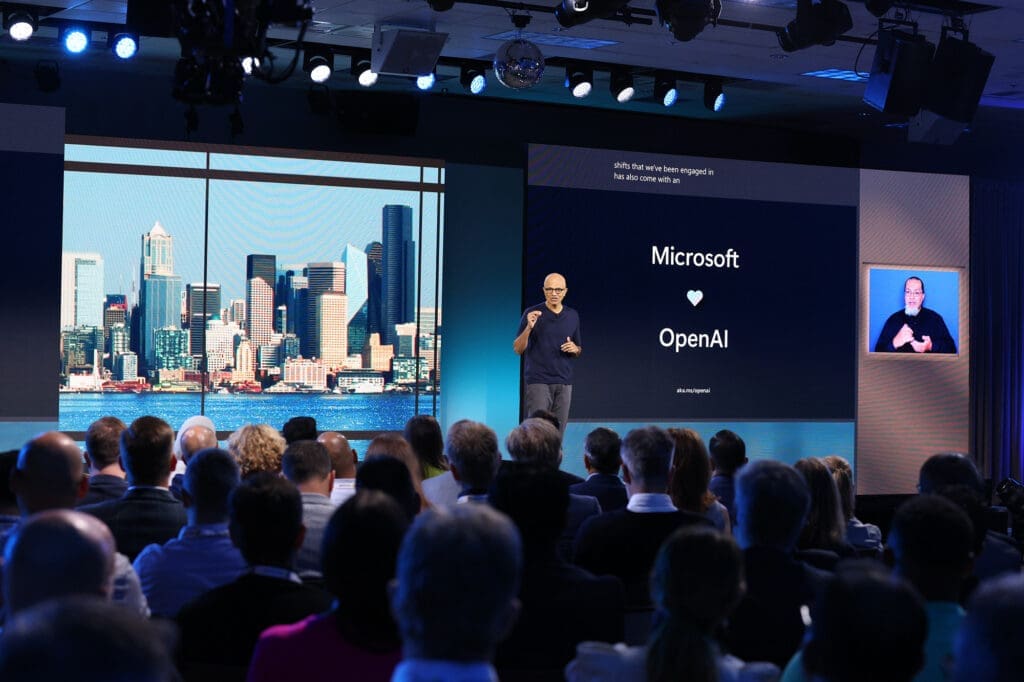
The evening opened with Microsoft’s vision for the next era of enterprise transformation. The keynote, hosted by Tatiana Arventi, AI Business Solutions Manager at Microsoft, showed us that AI has moved far beyond isolated pilots. Organisations across government, healthcare, finance and energy are already delivering measurable gains in productivity, resilience and customer experience through Microsoft’s trusted cloud and AI platform.
Key takeaways:
- AI acceleration requires structure, governance and a unified cloud foundation: True value emerges when organisations operate from a single, secure data and identity layer, not fragmented systems.
- Autonomous agents are becoming mainstream: Six in ten UK organisations are already deploying agents to automate reasoning, analysis and operational tasks.
- The next frontier blends intelligence and trust: In a regulated sector like wealth, responsible AI practices are not optional – they are fundamental to sustainable adoption.
Grounding the opportunity in Wealth Management’s reality
Oli Hymas, Senior Business Manager at Xpedition, explored the pressures facing leaders in Wealth Management today, and why AI alone cannot solve them.
Firms are navigating:
- The Great Wealth Transfer, transforming expectations and loyalty patterns
- Lower client retention driven by digital-first inheritors
- Consumer Duty & DORA, raising the bar on operational resilience and evidencing outcomes
- Private markets growth and rising demand for alternatives
- Cost-to-serve pressures and adviser capacity constraints
- Fragmented systems and manual workflows, blocking personalisation and compliance at scale
The realities and risks of AI adoption
The roundtable discussion was candid, pragmatic and deeply grounded in real operational realities across wealth firms – from global institutions to specialist boutiques.
AI must be battle‑tested – not blindly deployed
Executives repeatedly emphasised that AI must be stress tested, validated and deliberately “broken” in controlled conditions before being trusted in production.
This echoed Microsoft’s foundation of intelligence and trust.
Wealth firms are stuck in a regulatory catch‑22
Wealth firms today face a regulatory catch‑22 that is slowing transformation across the industry. Move too quickly with AI and digital automation, and firms risk introducing model drift, suitability inconsistencies, documentation gaps or misaligned reasoning that could trigger regulatory concern. But move too slowly, and outdated systems, manual processes and incomplete evidence trails become their own form of Consumer Duty or DORA non‑compliance. In practice, both extremes lead to the same outcome: heightened regulatory exposure.
This tension is creating a culture of caution, where firms recognise the need to modernise but cannot afford missteps. It’s why structured governance, controlled AI adoption and unified data foundations are becoming essential. The challenge is no longer about choosing speed or safety – it’s about building the operating environment that allows both to coexist.
The hidden variable in transformation
One of the strongest themes of the evening was the sheer variability of culture and risk appetite across wealth firms. Some organisations feel genuinely energised by the possibilities of AI and are already building controlled sandboxes, validating new workflows and empowering teams to experiment. Others, however, remain paralysed by the fear of regulatory missteps, worried that even incremental innovation could expose them to scrutiny.
What emerged is that technology itself is rarely the limiting factor – but culture is. The most successful firms are the ones that are creating space for innovation while maintaining robust oversight, embedding clear guardrails and establishing decision‑making frameworks that give teams the confidence to adopt new capabilities safely.
Data fragmentation: The universal root cause
No matter the specific challenge – whether onboarding delays, inconsistent suitability assessments, inefficient servicing or limited personalisation – many firms have traced their pain points back to a common issue: fragmented data. Without unified, high-quality data, even the most sophisticated AI models and digital experiences can fall apart.
The industry now recognises that automation, personalisation and compliant advice journeys all rely on a single foundation: connected, reliable client intelligence. Fragmentation doesn’t just slow transformation — it makes it impossible. Every aspiration raised during the roundtable ultimately required the same prerequisite: a unified data estate.
The next wave of automation
Looking ahead, leaders agreed that the real frontier is not just AI copilots augmenting human work, but autonomous workflows handling entire layers of operational complexity. Participants described a near-term future where suitability checks are continuous rather than periodic; fund switch reasoning generates itself; risk signals surface in real time; onboarding journeys guide advisers through each step automatically; and review packs assemble themselves without manual intervention.
But this future will only be safe and credible if firms build strong controls, guardrails and governance around these systems. Automation without oversight is simply another form of risk. The firms that succeed will be those who combine the efficiency of autonomous workflows with the assurance of robust supervision.
What this means for the future – and for Frontier Firms
A new operating model is taking shape for the wealth sector – one that is AI‑powered, data‑driven, human‑centred and governed by design. The discussions illuminated how Microsoft Dynamics 365 and Copilot are increasingly positioned not as tools, but as the operating layer that connects engagement, onboarding, service, compliance, vulnerability management, document intelligence and relationship insights into one coherent, trusted ecosystem.
The single, auditable Microsoft cloud environment gives firms the ability to modernise end‑to‑end journeys, unify their data estate, embed governance into every workflow, scale human expertise through intelligent automation, and build trust into every client and adviser interaction. And it is precisely in this environment that Xpedition – as part of Transparity, the UK’s most accredited Microsoft partner – delivers its strongest value, helping firms translate ambition into safe, measurable and future‑proof transformation.
The Digi‑Wealth Dinner revealed an industry that understands the urgency of transformation but is equally aware of the risks of getting it wrong. Technology is advancing faster than ever, but competitive advantage will not be won through AI alone. It will be won by the firms that redesign their operating models, unify and govern their data, and embed trust as a core architectural principle.
Microsoft Dynamics CRM Solutions
Endless possibilities to help solve your business challenges